The following model tries to assign jobs to ‘bins’ in such a way that the remaining space in the bins is as large as possible (i.e. as little fragmentation as possible so that we have capacity left for large jobs).
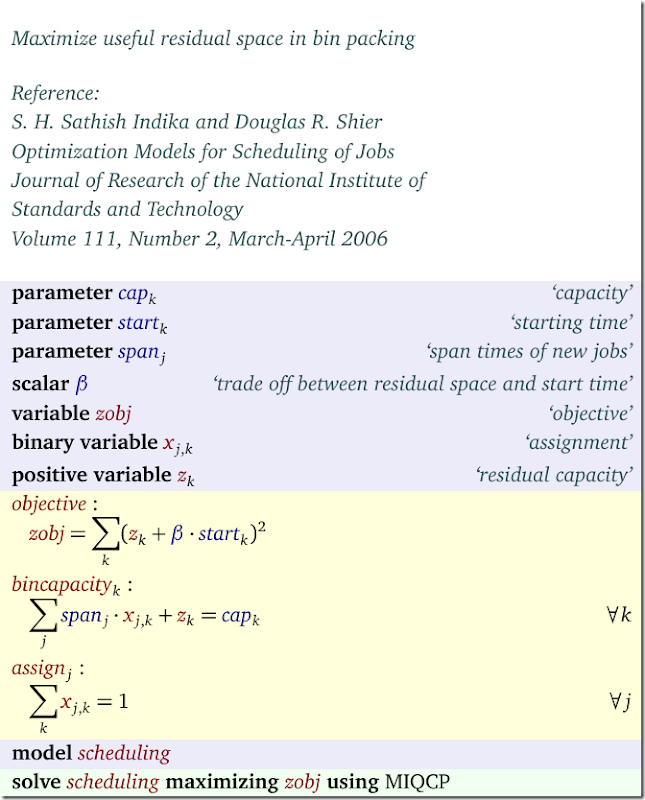
Essentially we place high value on large values on remaining capacity zk. We consider here cases with β=0 (if β>0 we also like jobs to be executed early: remaining capacity more in the future is more valuable). This is a non-convex problem so not so easy to solve. This is also the model discussed here.
With Cplex’s global MIQP solver (http://www.orsj.or.jp/ramp/2014/paper/4-3.pdf) we have now at least three ways to solve this problem with Cplex:(global MIQP, MIP with SOS2 interpolation, MIP with binaries exploiting integer data for capacity and job spans). Using an expanded (larger) version of the dataset provided in the paper with 27 bins and 15 jobs to allocate we try a few formulations.
- The global MIQP formulation uses the above model directly. We solve to optimality with 4 threads.
- We can add a small value for β to try to reduce some symmetry in the model. We are still aiming for large remaining capacities, but we add a little bit of noise to distinguish similar solutions. The purpose is not really to add a ‘schedule as early as possible’ objective but rather just to increase the performance of the branch-and-bound algorithm. In the experiment we use β=0.01. Note: this may not always give us the same optimal solution.
- We can use a piecewise linear formulation using SOS2 variables. In this case we used 4 segments. Obviously this is an approximation, so we may arrive at a different optimal solution. However in this case just using 4 segments is good enough to find the global optimum.
- We can assume all capacity and job length data is integer (as is the case for the example data sets in the paper), and use this to formulate a linear model with extra binary variables. If all data is integer valued this will give us the proven optimal solution of the original MIQP.
Here are the results:

The authors of the original paper did not explore these alternatives but concluded quickly the global MIQP was too slow and implemented a meta-heuristic. I am not sure if they would have done the same if they saw these results.