In a set cover problem (http://en.wikipedia.org/wiki/Set_cover_problem) we can organize the sets in two different ways:
- Use a (sparse) two dimensional set. The cover equation will contain a construct like: sum[c(s,i), x(s)].
- Use a (sparse) zero-one parameter. In this case the cover equation can have something like: sum[s, c(s,i)*x(s)].
The question came up. What is better? I like the set construct a bit better but that is purely based on aesthetics. The performance is exactly the same.
| Data structure: set | Data structure: 0/1 parameter |
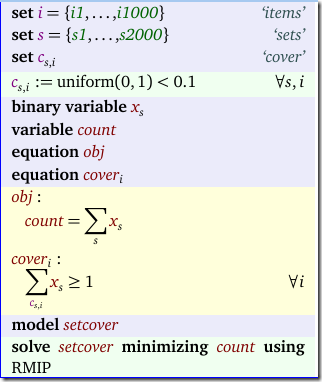 |  |
The sets are randomly generated. We solve here just as an LP as we are only interested in the performance of GAMS generating the problem.