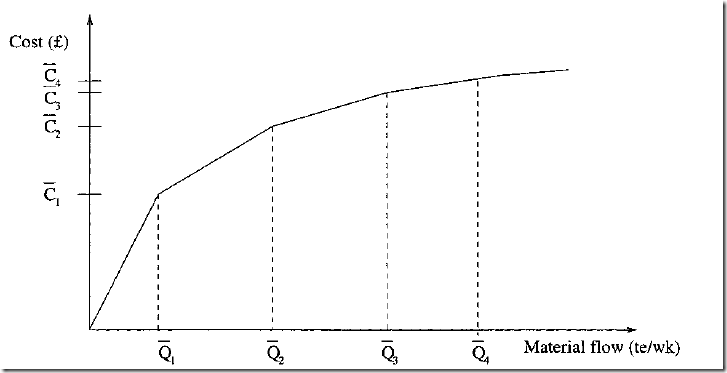
Here is a simple case of a piecewise linear function. It shows economies of scale: shipping more leads to lower unit transportation costs.
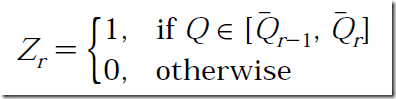
One way of modeling this is using a set of binary variables indicating in which segment we are:
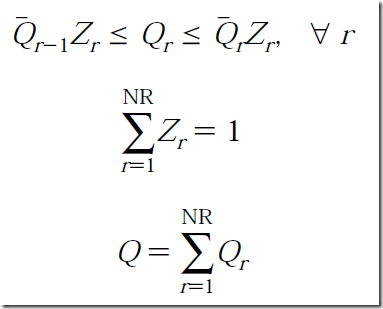
Then some addition constraints are needed:
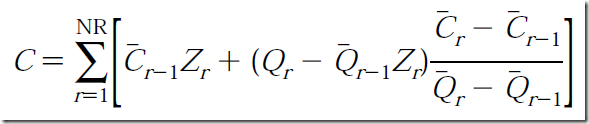
and finally we can produce an equation that forms the cost:
When looking at the data:
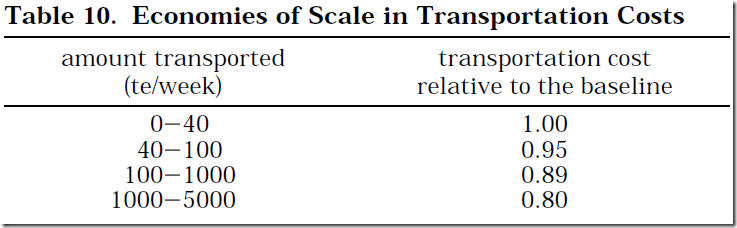
we can do one simplification: the terms 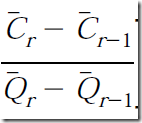
can be replaced with the coefficients from this table. So a formulation in GAMS could look like:
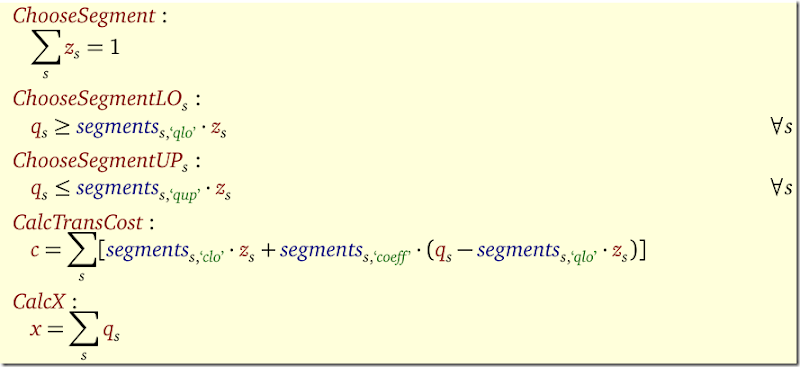
Usually when I see such structures I first verify if indeed we need binary variables at all (if the cost structure is convex we don’t need them at all). The problem is non-convex so we really need them. The second idea is to use SOS2 variables. Many MIP solvers support SOS2 variables which are designed to these interpolation tasks (see: http://yetanothermathprogrammingconsultant.blogspot.com/2009/06/gams-piecewise-linear-functions-with.html). Let’s see if that simplifies things.
First of all we need to think in points instead of segments. So instead of 4 segments we have now 5 points. We need x and y data (here “q” and “c” data) for these points. Once we calculated the table with the x and y values at the kinks we simply introduce a SOS2 variable λ and we are ready to go:
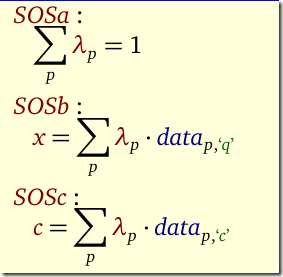
This is certainly a lot simpler.
This will for sure pay off in larger models. E.g. now I am looking at something like:
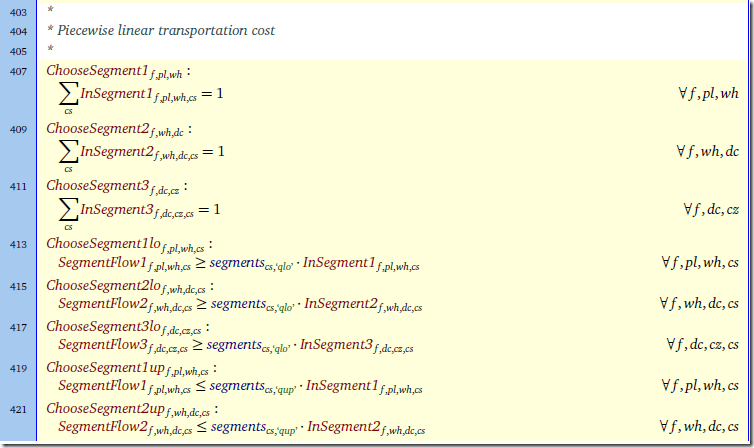
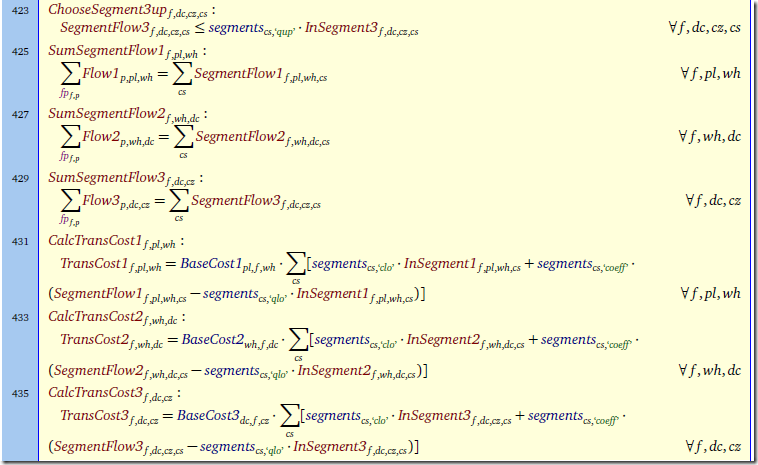
Using a proper SOS formulation this can look much less intimidating.
But there is a catch for this model. The SOS2 formulation turns out to be much slower:
| Method | Cplex time |
| Binary variables | Total (root+branch&cut) = 1.95 sec. (488.02 ticks) |
| SOS2 variables | Total (root+branch&cut) = 79.00 sec. (26865.76 ticks) |
I am not sure if this is just a fluke or if the formulation with the binary variables is really better.
Reference: P. Tsiakis, N. Shah, and C. C. Pantelides, Design of Multi-echelon Supply Chain Networks under Demand Uncertainty, Ind. Eng. Chem. Res. 2001, 40, 3585-3604.