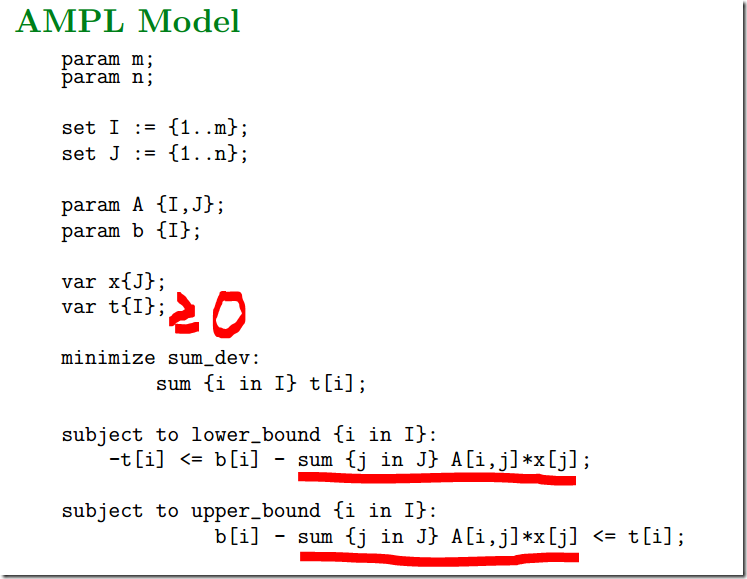
This is a modeling construct I see re-occurring at regular intervals. One formulation is given here:
http://www.princeton.edu/~rvdb/542/lectures/lec9.pdf
I would typically write this slightly differently:
- declare t as a positive variable (this is implied by equations lower_bound and upper_bound; I prefer this to be explicit)
- add extra variable and constraint to prevent the duplicate expression (this will add rows and columns to the model but reduces the number of nonzero elements)
Another formulation I often propose is using variable splitting:
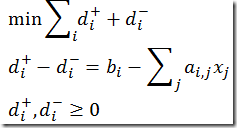
One of the pair d(i,plus),d(i,minus) will be zero. Two arguments:
- If both nonzero then not optimal: we can decrease the objective
- For Simplex methods: the basis matrix will becomes singular (not invertible) when both are in the basis. I.e. one of the pair will be non-basic, and thus zero.
Currently I am working on an application where we want to have a different weight for positive and negative deviations. This can directly be applied to the last formulation.
To back this up I generated a ridiculously large problem (although I have seen models of this size in practice!): 10000 observations and 100 independent variables. This leads to:
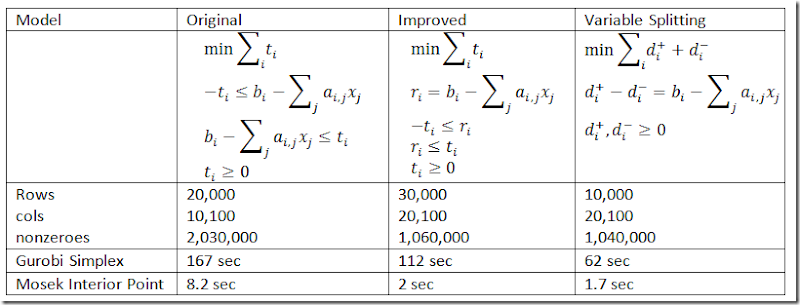
I ran with default settings for the solvers.
Some conclusions:
- Interior point codes do very well on some large instances
- Our improvements help (only really matters for these crazy large instances)
- Variable splitting is actually pretty good on this particular problem
- Speed improvements are similar for different solution methods (simplex, barrier)
- I also ran the problems with Gurobi’s barrier solver: almost as fast as Mosek
Update: I should have added that I have not looked at dual formulations as my main interest was a more complex model than a pure L1 regression model. We want to keep the formulation close to the problem and an explicit dual formulation makes the model much more difficult to understand and maintain.