 |
| U-Haul Moving Van [link] |
This is a strange little problem [1]. We have individuals (of different categories) and regions with a given capacity. The initial set of assigned persons fits within the capacity of each region. Now a new batch of individuals arrives with their chosen zones. Unfortunately, the total demand (old + new individuals) does not fit anymore in all cases. This means we need to reallocate people. We can do this at a price (the costs are given). What is the optimal (least cost) new allocation?
Data
The data we need to consider is:
----     35 PARAMETER popdatapopulation data

               initial       added       final

catA.zone1         11523138
catA.zone2         12124145
catA.zone3         11222134
catA.zone4          761591
catB.zone1          702999
catB.zone2          592483
catB.zone3          8635121
catB.zone4         13957196
catC.zone1         14218160
catC.zone2          72981
catC.zone3          29433
catC.zone4          58866
catD.zone1          222547
catD.zone2          232649
catD.zone3          161834
catD.zone4          455196


----     44 PARAMETER capacity  total capacity per zone

zone1 465,    zone2 393,    zone3 500,    zone4 331


----     66 PARAMETER costcost moving to target zone

           zone1       zone2       zone3       zone4

catA         0.10.10.11.3
catB        16.238.11.50.1
catC         0.112.797.746.3
catD        25.37.767.30.1


----     80 PARAMETER countssummary data

               zone1       zone2       zone3       zone4       total

initial          3492752433181185
final            4443583224491573
capacity         4653935003311689
Model
| LP model |
|---|
| \[\begin{align}\min&\sum_{c,z,z'} \color{darkblue}{\mathit{cost}}_{c,z'}\cdot\color{darkred}{\mathit{move}}_{c,z,z'} \\ & \color{darkred}{\mathit{alloc}}_{c,z} = \color{darkblue}{\mathit{demand}}_{c,z} + \sum_{z'}\color{darkred}{\mathit{move}}_{c,z',z} - \sum_{z'}\color{darkred}{\mathit{move}}_{c,z,z'} && \forall c,z \\ & \sum_c \color{darkred}{\mathit{alloc}}_{c,z} \le \color{darkblue}{\mathit{capacity}}_{z} && \forall z \\ & \color{darkred}{\mathit{move}}_{c,z,z}= 0 && \forall c,z \\ & \color{darkred}{\mathit{move}}_{c,z',z} \ge 0 \\ &\color{darkred}{\mathit{alloc}}_{c,z} \ge 0 \end{align}\] |
Notes:
- The first constraint says: \[\text{allocation$=$demand $+$ inflow $-$ outflow}\] This is just proper bookkeeping.
- The model seems to deliver integer solutions, which makes it easier to interpret results. Not sure if this is guaranteed.
- We cannot substitute out the variable \(\color{darkred}{\mathit{alloc}}_{c,z}\) as it is non-negative. I'll show below what happens when we do that anyway.
- We can drop the constraint \(\color{darkred}{\mathit{move}}_{c,z,z}= 0\). This will automatically hold in the optimal solution as we are minimizing cost. If we choose to keep it, we can use fixing (setting the upper bound to zero) instead of writing a full-blown equation. For large models, it may be a good strategy to drop \(\color{darkred}{\mathit{move}}_{c,z,z} \) from the model altogether.
In any case, a good presolver will remove \(\color{darkred}{\mathit{move}}_{c,z,z} \) from the model. These variables cancel out in the first constraint, so they only appear in the objective. - Here we assumed that all people can be moved. Later on, we see how things change when we only allow the new, additional individuals are allowed to be reassigned.
----    122 VARIABLE move.L  moves needed to meet capacity

                 zone1       zone2       zone3

catA.zone1                       6
catA.zone4                      2962
catC.zone4          27


----    122 VARIABLE alloc.L  new allocation

           zone1       zone2       zone3       zone4

catA         132180196
catB          9983121196
catC         187813339
catD          47493496


----    122 VARIABLE totcost.L             =       12.400total cost

----    126 PARAMETER countssummary data

               zone1       zone2       zone3       zone4       total

initial          3492752433181185
final            4443583224491573
capacity         4653935003311689
newalloc         4653933843311573
This is an interesting solution. Obviously, we need to move people away from zone 4. The model first moves a few persons from zone 1 to zone 2 to make room in zone 1. I.e., we actually move two people here to move 1 person away from zone 4. Of course, this highly depends on the cost structure.
Alternative 1: substitute out the variable \(\color{darkred}{\mathit{alloc}}_{c,z}\)
This makes the model smaller. So what is not to like. Here are the results:
----    144 VARIABLE move.L  moves needed to meet capacity

                 zone2       zone3

catA.zone4          3583


----    144 VARIABLE totcost.L             =       11.800total cost

----    144 PARAMETER alloc2  recalculate allocations

           zone1       zone2       zone3       zone4

catA     138.000180.000217.000     -27.000
catB      99.00083.000121.000196.000
catC     160.00081.00033.00066.000
catD      47.00049.00034.00096.000
The objective improves (from 12.4 to 11.8)! Without further analysis, it is not immediately clear why this happens. So I added a post solution calculation of the new allocations: \[\color{darkblue}{\mathit{alloc2}}_{c,z} := \color{darkblue}{\mathit{demand}}_{c,z} + \sum_{z'}\color{darkred}{\mathit{move}}^*_{c,z',z} - \sum_{z'}\color{darkred}{\mathit{move}}^*_{c,z,z'}\] This shows we have a negative allocation for category 4 and zone 4. The reason is of course that with substituting out \(\color{darkred}{\mathit{alloc}}_{c,z}\) we also removed the non-negativity restriction \(\color{darkred}{\mathit{alloc}}_{c,z} \ge 0\). As a result we get an illegal solution.
Conclusion: we cannot do this.
Alternative 2: only move new people
---    158 VARIABLE move.L  moves needed to meet capacity

                 zone1       zone2       zone3

catA.zone2                                   3
catA.zone4          132
catB.zone4                                  57
catC.zone4           8
catD.zone4                      38


----    158 VARIABLE alloc.L  new allocation

           zone1       zone2       zone3       zone4

catA          362127
catB          292492
catC          2694
catD          25641813


----    158 VARIABLE totcost.L             =      380.700  total cost

----    162 PARAMETER counts  summary data

               zone1       zone2       zone3       zone4       total

initial          3492752433181185
final            4443583224491573
capacity         4653935003311689
newalloc         4653933843311573
Indeed the cost of moving just from the pool of added persons is much higher.
Network formulation
In the comments, Rob Pratt uses a network interpretation to argue that the model should indeed deliver integer solutions. A second comment further helped in simplifying the network model.
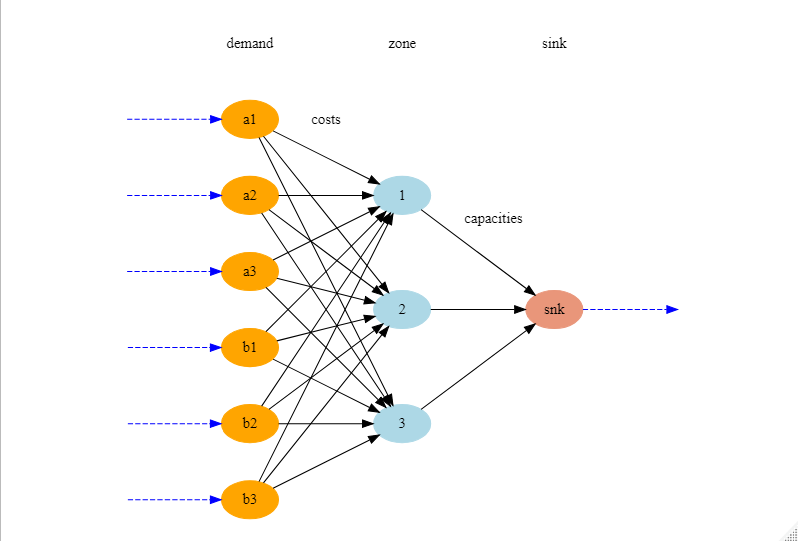
This is a good example to show how to set up a network LP in GAMS. The idea is to form a network as follows:
 |
| Network representation |
The dashed arrows indicate fixed, exogenous in- or outflow. The inflow into the first layer is demand. The second layer contains the zones with the arcs indicating the new allocation after moving people. The final layer collects the total number of persons. The main use for that last layer is to provide capacitated arcs and to have a single outflow. The costs are placed on the arcs between the first and second layer.
To implement this in GAMS, I first create a 2-dimensional set with nodes. The dimensions are (category, zone). I use a 'all' when there is no category, and 'sink' for the aggregated zones. So the sink is identified by ('all','sink'). This means, our arcs have 4 dimensions. These two sets can look like:
----     98 SET nnodes

           zone1       zone2       zone3       zone4        sink

catA         YES         YES         YES         YES
catB         YES         YES         YES         YES
catC         YES         YES         YES         YES
catD         YES         YES         YES         YES
all          YES         YES         YES         YES         YES


----     98 SET aarcs

             all.zone1   all.zone2   all.zone3   all.zone4    all.sink

catA.zone1         YES         YES         YES         YES
catA.zone2         YES         YES         YES         YES
catA.zone3         YES         YES         YES         YES
catA.zone4         YES         YES         YES         YES
catB.zone1         YES         YES         YES         YES
catB.zone2         YES         YES         YES         YES
catB.zone3         YES         YES         YES         YES
catB.zone4         YES         YES         YES         YES
catC.zone1         YES         YES         YES         YES
catC.zone2         YES         YES         YES         YES
catC.zone3         YES         YES         YES         YES
catC.zone4         YES         YES         YES         YES
catD.zone1         YES         YES         YES         YES
catD.zone2         YES         YES         YES         YES
catD.zone3         YES         YES         YES         YES
catD.zone4         YES         YES         YES         YES
all .zone1                                                         YES
all .zone2                                                         YES
all .zone3                                                         YES
all .zone4                                                         YES
We also have some capacities, costs, and exogenous inflows. They are:
----    112 PARAMETER acost  cost of an arc

             all.zone1   all.zone2   all.zone3   all.zone4

catA.zone1                     0.10.11.3
catA.zone2         0.10.11.3
catA.zone3         0.10.11.3
catA.zone4         0.10.10.1
catB.zone1                    38.11.50.1
catB.zone2        16.21.50.1
catB.zone3        16.238.10.1
catB.zone4        16.238.11.5
catC.zone1                    12.797.746.3
catC.zone2         0.197.746.3
catC.zone3         0.112.746.3
catC.zone4         0.112.797.7
catD.zone1                     7.767.30.1
catD.zone2        25.367.30.1
catD.zone3        25.37.70.1
catD.zone4        25.37.767.3


----    112 PARAMETER inflow  exogenous in- or outflow

           zone1       zone2       zone3       zone4        sink

catA         13814513491
catB          9983121196
catC         160813366
catD          47493496
all                                                        -1573


----    112 PARAMETER capcapacity of an arc

             all.sink

all.zone1         465
all.zone2         393
all.zone3         500
all.zone4         331
With this we can form a standard min-cost-flow LP model:
| Min-Cost-Flow Network LP Model |
|---|
| \[\begin{align}\min&\sum_{a} \color{darkblue}c_{a} \cdot \color{darkred}f_{a} \\ & \sum_{a(j,i)} \color{darkred}f_{j,i} + \color{darkblue}{\mathit{inflow}}_i = \sum_{a(i,j)} \color{darkred}f_{i,j} && \forall i \\ & \color{darkred}f_a \in [0,\color{darkblue}{\mathit{cap}}_a] \end{align}\] |
----    141 VARIABLE flow.L  flows along arcs

             all.zone1   all.zone2   all.zone3   all.zone4    all.sink

catA.zone1         1326
catA.zone2                     145
catA.zone3                                 134
catA.zone4                      2962
catB.zone1          99
catB.zone2                      83
catB.zone3                                 121
catB.zone4                                             196
catC.zone1         160
catC.zone2                      81
catC.zone3                                  33
catC.zone4          2739
catD.zone1          47
catD.zone2                      49
catD.zone3                                  34
catD.zone4                                              96
all .zone1                                                         465
all .zone2                                                         393
all .zone3                                                         384
all .zone4                                                         331


----    141 VARIABLE totcost.L             =       12.400total cost

----    146 PARAMETER moves  computed from flows

                 zone1       zone2       zone3

catA.zone1                       6
catA.zone4                      2962
catC.zone4          27
Notes:
- Although we formulate the problem as a network, I still solve it as an LP. For very large problems it is better to use a specialized network solver.
- The arc costs need a bit of attention. It is important to give the arcs from layer 'demand' to 'zone' a zero cost when the zone doesn't change. In the original LP model we did not care, as we modeled this slightly differently.
- When we want to move only newly added persons, we can preprocess the data, as was demonstrated for the LP formulation.
- My first attempt had an extra layer in the graph. As a commenter noted, this could be simplified. My description and the network topology reflect this simplification.
Conclusion
This is a small but interesting model. In [1] an R/LPSolve implementation is given. When comparing this with my GAMS model (reproduced in the appendix below), I have to conclude that using R/LpSolve is slightly masochistic. The code is unwieldy and not very close to the original problem. This makes reasoning about the problem much more difficult.
Setting up the alternative network model is a very different exercise than the earlier LP models. The min-cost-flow model is quite standard, so we don't have to think long about the model equations. But we have to pay attention to the network topology: that is where the complexity is. It is interesting to compare the two modeling approaches.
References
- Minimise cost of reallocating individuals, https://stackoverflow.com/questions/69046256/minimise-cost-of-reallocating-individuals
Appendix A: GAMS LP model
set |
Appendix B: GAMS Network LP model
$ontext |