This post is about what sometimes is called a 2d knapsack problem. It can also be considered as a bin-packing problem.
So, we have one 2d container of a given size. Furthermore, we have a collection of items: rectangles of a given size, with a value. The goal is to pack items in our container without overlapping each other such that the total value is maximized.
To make things concrete. let's have a look at a small data set (randomly generated):
----     18 PARAMETER dataproblem data

                width      height   available       value  value/size

k1             20.0004.0002.000338.9844.237
k2             12.00017.0006.000849.2464.163
k3             20.00012.0002.000524.0222.183
k4             16.0007.0009.000263.3032.351
k5              3.0006.0003.000113.4366.302
k6             13.0005.0003.000551.0728.478
k7              4.0007.0006.00086.1663.077
k8              6.00018.0008.000755.0946.992
k9             14.0002.0007.000223.5167.983
k10             9.00011.0005.000369.5603.733
container      30.00020.000
Our container is \(30\times 20\). We have 10 different types of items. The column available indicates the number of items of the current type. This means we have actually 51 items. Instead of value, it may be better to look at the value/size column. This is the relative value, normalized for size (i.e. height times width). The four most valuable items are k6, k9, k8, and k5. Hopefully, we will see them back in the solution.
An interesting wrinkle is: the items can be rotated. There are different ways of handling this. We can duplicate all items and add a rotated version. However, we need to make sure that the availability limit is applied to both. In the first MIP model below, I decided to add a rotation index \(r\) to indicate whether an item is rotated. This is almost the same as duplicating items. In the second model, I introduce an explicit binary variable to indicate whether the item is rotated.
I am not really asking for an arrangement of the selected items, but all the models I know of, produce an actual non-overlapping configuration.
A covering model
For this model, we assume that the container is a grid of cells, and each item occupies a number of cells. In other words, I assume the width and height are integer-valued. The main decision variable is: \[\color{darkred}x_{k,r,i,j} = \begin{cases} 1 & \text{if an item of type $k$ and direction $r$ is placed at cell \((i,j)\)} \\ 0 & \text{otherwise}\end{cases}\] The index \(r\) has two elements: \({r,nr}\) indicating if the corresponding item \(k\) is rotated or not. My convention is: if \(\color{darkred}x_{k,r,i,j}=1\) for a non-rotated item, then cells \((i',j')\), with \(i'=i,..,i+\color{darkblue}{\mathit{width}}_k-1\) and \(j'=j,..,j+\color{darkblue}{\mathit{height}}_k-1\) are occupied by this item. We need some rule to precisely state what it means if an item \(k\) is placed at \((i,j)\).
The first thing I did was creating two sets: \(\color{darkblue}{\mathit{ok}}\) and \(\color{darkblue}{\mathit{cover}}\).
The first set is \(\color{darkblue}{\mathit{ok}}_{k,r,i,j}\) indicating the allowed cells \((i,j)\) where we can place an item of type \(k\) (rotated or not). Below we see the allowed assignments of item k3:
 |
| ok(k,r,i,j) |
The second set is \(\color{darkblue}{\mathit{cover}}_{k,r,i,j,i',j'}\) indicating which cells \((i',j')\) are covered when placing item \(k\) on cell \((i,j)\). This is a large 6 dimensional set. It has 282,944 elements.
 |
| cover(k,r,i,j,ii,jj) |
Here we see the coverage when we place item k1 at (r4,c6) (not rotated).
With this we can write our covering model:
| Covering Model |
|---|
| \[\begin{align}\max&\>\color{darkred}{\mathit{totalValue}} = \sum_{k,r,i,j|\color{darkblue}{\mathit{ok}}(k,r,i,j)} \color{darkblue}{\mathit{value}}_k \cdot \color{darkred}x_{k,r,i,j} && &&\text{Maximize total value}\\ & \sum_{k,r,i,j|\color{darkblue}{\mathit{cover}}(k,r,i,j,i',j')}\color{darkred}x_{k,r,i,j} \le 1 && \forall i',j'&& \text{No overlap} \\ & \sum_{r,i,j|\color{darkblue}{\mathit{ok}}(k,r,i,j)} \color{darkred}x_{k,r,i,j} \le \color{darkblue}{\mathit{avail}}_k &&\forall k && \text{Availability} \\ & \color{darkred}x_{k,r,i,j} \in \{0,1\} \end{align}\] |
I considered adding the constraint: \[\sum_{k,r,i,j|\color{darkblue}{\mathit{ok}}(k,r,i,j)} \color{darkblue}{\mathit{area}}_k \cdot \color{darkred}x_{k,r,i,j} \le \color{darkblue}{\mathit{containerSize}}\] This did not seem to be much of a help.
The model is not very small:
MODEL STATISTICS

BLOCKS OF EQUATIONS           3     SINGLE EQUATIONS          611
BLOCKS OF VARIABLES           2     SINGLE VARIABLES        4,273
NON ZERO ELEMENTS       291,489     DISCRETE VARIABLES      4,272
However, this model solves quickly: just 63 nodes were needed. The results are:
----     83 VARIABLE x.L  item k is placed at (i,j)

             r1.c1      r1.c14      r1.c28      r3.c14      r5.c14       r6.c1       r6.c6      r7.c11      r7.c29

k5 .nr                                   1
k6 .nr           1
k6 .r                                                                        11
k8 .r                                                                                                1
k9 .nr                       111
k9 .r                                                                                                            1

     +     r13.c11      r19.c1     r19.c15

k8 .r            1
k9 .nr                       11


----     83 VARIABLE totalValue.L          =     4617.938objective (maximized)

A continuous size model
Intermezzo: pairwise no-overlap constraints. These constraints are: \[\begin{align} \color{darkred}x_a &\ge \color{darkred}x_b + \color{darkblue}w_b \\ {\bf or}\>\color{darkred}x_b &\ge \color{darkred}x_a + \color{darkblue}w_a \\ {\bf or}\>\color{darkred}y_a &\ge \color{darkred}y_b + \color{darkblue}h_b \\ {\bf or}\>\color{darkred}y_b &\ge \color{darkred}y_a + \color{darkblue}h_a \end{align}\] The or conditions can be implemented with additional binary variable and big-M constraints: \[\begin{align} & \color{darkred}x_a \ge \color{darkred}x_b + \color{darkblue}w_b - \color{darkblue}M \cdot (1-\color{darkred} \delta_{a,b,1})\\ & \color{darkred}x_b \ge \color{darkred}x_a + \color{darkblue}w_a - \color{darkblue}M \cdot (1-\color{darkred} \delta_{a,b,2})\\ &\color{darkred}y_a \ge \color{darkred}y_b + \color{darkblue}h_b - \color{darkblue}M \cdot (1-\color{darkred} \delta_{a,b,3})\\ & \color{darkred}y_b \ge \color{darkred}y_a + \color{darkblue}h_a - \color{darkblue}M \cdot (1-\color{darkred} \delta_{a,b,4}) \\ & \sum_k \color{darkred}\delta_{a,b,k} \ge 1 \end{align}\] We need to add one more detail: we want to have these constraints only active if both items a and b are selected to be in our container. So our constraints become: \[\begin{align} & \color{darkred}x_a \ge \color{darkred}x_b + \color{darkblue}w_b - \color{darkblue}M \cdot (1-\color{darkred} \delta_{a,b,1}) - \color{darkblue}M\cdot (1-\color{darkred}{\mathit{selected}}_a) - \color{darkblue}M\cdot (1-\color{darkred}{\mathit{selected}}_b)\\ & \color{darkred}x_b \ge \color{darkred}x_a + \color{darkblue}w_a - \color{darkblue}M \cdot (1-\color{darkred} \delta_{a,b,2}) - \color{darkblue}M\cdot (1-\color{darkred}{\mathit{selected}}_a) - \color{darkblue}M\cdot (1-\color{darkred}{\mathit{selected}}_b)\\ &\color{darkred}y_a \ge \color{darkred}y_b + \color{darkblue}h_b - \color{darkblue}M \cdot (1-\color{darkred} \delta_{a,b,3})- \color{darkblue}M\cdot (1-\color{darkred}{\mathit{selected}}_a) - \color{darkblue}M\cdot (1-\color{darkred}{\mathit{selected}}_b) \\ & \color{darkred}y_b \ge \color{darkred}y_a + \color{darkblue}h_a - \color{darkblue}M \cdot (1-\color{darkred} \delta_{a,b,4}) - \color{darkblue}M\cdot (1-\color{darkred}{\mathit{selected}}_a) - \color{darkblue}M\cdot (1-\color{darkred}{\mathit{selected}}_b)\\ & \sum_k \color{darkred}\delta_{a,b,k} \ge 1 \end{align}\] The final complication is that we can rotate items. So the width can become the hight and vice versa.
----     56 SET kn(k,n) combinations

             n1          n2          n3          n4          n5          n6          n7          n8          n9

k1          YES         YES
k2          YES         YES         YES         YES         YES         YES
k3          YES         YES
k4          YES         YES         YES         YES         YES         YES         YES         YES         YES
k5          YES         YES         YES
k6          YES         YES         YES
k7          YES         YES         YES         YES         YES         YES
k8          YES         YES         YES         YES         YES         YES         YES         YES
k9          YES         YES         YES         YES         YES         YES         YES
k10         YES         YES         YES         YES         YES


----     56 PARAMETER numsequence numbers for (k,n)

             n1          n2          n3          n4          n5          n6          n7          n8          n9

k1            12
k2            345678
k3            910
k4           111213141516171819
k5           202122
k6           232425
k7           262728293031
k8           3233343536373839
k9           40414243444546
k10          4748495051
 |
| Items to compare |
| Continuous size model |
|---|
| \[\begin{align} \max\> & \color{darkred}{\mathit{totalValue}} = \sum_{\color{darkblue}{\mathit{kn}}(k,n)} \color{darkblue}{\mathit{value}}_k \cdot \color{darkred}x_{k,n} && && \text{Maximize total value}\\ & \color{darkred}{\mathit{pos2}}_{k,n,xy} = \color{darkred}{\mathit{pos}}_{k,n,xy} + \color{darkblue}{\mathit{wh}}_{k,R,xy}\cdot \color{darkred}{\mathit{rot}}_{k,n} + \color{darkblue}{\mathit{wh}}_{k,{\mathit{NR}},xy}\cdot (1-\color{darkred}{\mathit{rot}}_{k,n}) &&\forall \color{darkblue}{\mathit{kn}}_{k,n},xy&&\text{End-point of item} \\ & \color{darkred}{\mathit{pos}}_{k,n,xy} \ge \color{darkred}{\mathit{pos2}}_{k',n',xy} - \color{darkblue}M \cdot (3-\color{darkred}\delta_{k,n,k',n',xy,1}-\color{darkred}x_{k,n}-\color{darkred}x_{k',n'})&&\forall \color{darkblue}{\mathit{compare}}_{n,k,n',k'}, xy && \text{No overlap}\\ &\color{darkred}{\mathit{pos}}_{k',n',xy} \ge \color{darkred}{\mathit{pos2}}_{k,n,xy} - \color{darkblue}M \cdot (3-\color{darkred}\delta_{k,n,k',n',xy,2}-\color{darkred}x_{k,n}-\color{darkred}x_{k',n'})&&\forall \color{darkblue}{\mathit{compare}}_{n,k,n',k'},xy && \text{No overlap} \\ & \sum_{xy} \left( \color{darkred}\delta_{k,n,k',n',xy,1}+\color{darkred}\delta_{k,n,k',n',xy,2}\right)\ge 1 && \forall \color{darkblue}{\mathit{compare}}_{n,k,n',k'} && \text{No overlap}\end{align}\] |
- We can order turning on \(\color{darkred}x_{k,n}\) by \(n\): \[\color{darkred}x_{k,n-1}\ge\color{darkred}x_{k,n}\]
- We can order the variable \(\color{darkred}{\mathit{pos}}\) of the same type by their \(x\)-coordinate: \[\color{darkred}{\mathit{pos}}_{k,n-1,x}\le \color{darkred}{\mathit{pos}}_{k,n,x}\]
- We know that the total area of items cannot exceed the area of the container: \[\sum_{\color{darkblue}{\mathit{kn}}(k,n)} \color{darkblue}{\mathit{area}}_k \cdot \color{darkred}x_{k,n} \le \color{darkblue}{\mathit{containerArea}}\]
----    127 VARIABLE x.L  item (k,n) is placed (rotated/non-rotated)

             n1          n2          n3          n4          n5          n6

k5            1
k6            111
k8            11
k9            111111


----    127 PARAMETER positionsrectangles (x1,y1)-(x2,y2)

               x1          y1          x2          y2     rotated

k5.n1                               3.0006.000
k6.n1      17.00030.0005.000
k6.n2      20.0005.00025.00018.0001.000
k6.n3      25.0005.00030.00018.0001.000
k8.n1       2.00012.00020.00018.0001.000
k8.n2       2.0006.00020.00012.0001.000
k9.n1                   6.0002.00020.0001.000
k9.n2       2.00018.00016.00020.000
k9.n3       3.00017.0002.000
k9.n4       3.0004.00017.0006.000
k9.n5       3.0002.00017.0004.000
k9.n6      16.00018.00030.00020.000


----    127 VARIABLE totalValue.L          =     4617.938objective (maximized)
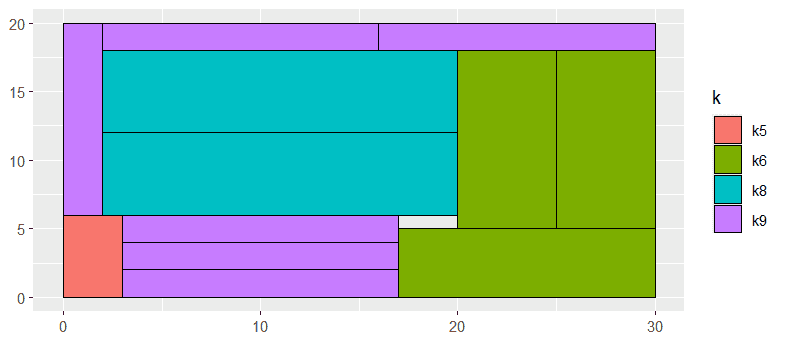 |
| Solution by continuous size model |
Notes
- Slightly different data can cause very different performance.
- The covering model is a bit faster than the continuous size model.
- The problem is very simple. The MIP models not so much.
- I did not try to duplicate items to model rotation. Just have two items: one not rotated and one rotated. Impose a constraint that says we can only pick one. That may be a bit simpler than what I tried, especially in the second model.
- I tried using Google or-tools using a similar scheme as in [1]. Unfortunately, my implementation did not give good results. It reproduced the above solution after 13k seconds:
13131.66s best:4617936 next:[4617937,21154899] fixed_bools:0/1338
Note that the objective coefficients were made integers (after multiplying by 1000). I am sure there are better formulations.
References
- 2d bin packing with Google OR-Tools CP-SAT, how to fix?, https://yetanothermathprogrammingconsultant.blogspot.com/2021/02/2d-bin-packing-with-google-or-tools-cp.html
Appendix 1: GAMS covering model
$ontext |
Appendix 2: GAMS continuous size model
$ontext |