Convert standard assignment problem to a network problem
A standard assignment problem formulated as an LP/MIP looks like:
| Assignment problem |
|---|
| \[\begin{align}\min&\sum_{i,j} \color{darkblue}c_{i,j}\cdot\color{darkred}x_{i,j}\\ & \sum_j \color{darkred}x_{i,j}=1 && \forall i \\ & \sum_i \color{darkred}x_{i,j}=1 && \forall j \\ & \color{darkred}x_{i,j} \in \{0,1\} \end{align}\] |
The variables can be relaxed to be continuous between 0 and 1: solutions are integer-valued automatically. Let's denote the size of this problem as \(n = |I| = |J|\). This is a balanced assignment problem: the matrices \(\color{darkred}x_{i,j}\) and \(\color{darkblue}c_{i,j}\) are square.
On the OR-Tools website, a min-cost flow network problem is constructed that represents this assignment problem [1]. Here workers are to be assigned to tasks (or the other way around), The picture of the network is:
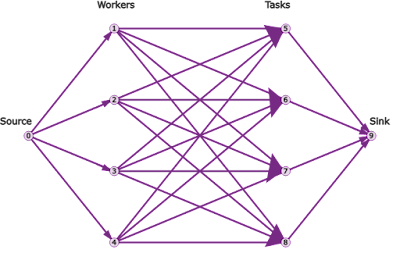 |
| Network from [1] |
Let's summarize each type of node and arc in this network:
| Node | Supply | Arc | Cost | Capacity | |
|---|---|---|---|---|---|
| Source node | \(n\) | source\(\rightarrow\)worker | \(0\) | \(1\) | |
| Worker nodes | \(0\) | worker\(\rightarrow\)task | \(c_{i,j}\) | \(1\) | |
| Task nodes | \(0\) | task\(\rightarrow\)sink | \(0\) | \(1\) | |
| Sink node | \(-n\) |
Supply indicates inflow from outside (not from other nodes). A negative supply means we have a demand. In this formulation, source and sink are the only nodes with supply (and demand).
There is a more compact formulation: get rid of the source and the sink node. Something like:

So we have:
| Node | Supply | Arc | Cost | Capacity | |
|---|---|---|---|---|---|
| Worker nodes | \(1\) | worker\(\rightarrow\)task | \(c_{i,j}\) | \(1\) | |
| Task nodes | \(-1\) |
This makes the problem a little bit smaller. We save two nodes and \(2n\) arcs.
So why did they add the source and sink node? Maybe for aesthetic reasons: to isolate the supply to just the source and sink node? Or to be better prepared for unbalanced assignment problems (although the script needs modification to handle that)?
Of course, the savings in problem size are modest. So this is more a case of nit-picking on my side than of a serious issue.
The OR-tools library min-cost flow algorithm has a few quirks.
- Only upper bounds (capacities) on the flows along the arcs are supported (lower bounds are always zero).
- All coefficients are integers.
- I believe there are no timing and iteration counts available (e.g. for comparison with an LP model -- of course iteration counts may be difficult to compare in any case).
An unbalanced variant
In [2] a different version of this problem is discussed. Here we have more tasks than workers. All tasks have to be assigned (so workers may need to perform more than one task). In addition, we require that a worker need to perform at least one task.
As I think of the problem as assigning tasks to workers, let's use \(i\) to indicate tasks and use \(j\) for workers. The LP/MIP model can look like:
| Unbalanced assignment problem |
|---|
| \[\begin{align}\min&\sum_{i,j} \color{darkblue}c_{i,j}\cdot\color{darkred}x_{i,j}\\ & \sum_j \color{darkred}x_{i,j}=1 && \forall i \\ & \sum_i \color{darkred}x_{i,j}\ge 1 && \forall j \\ & \color{darkred}x_{i,j} \in \{0,1\}\end{align}\] |
The matrices \(\color{darkred}x_{i,j}\) and \(\color{darkblue}c_{i,j}\) are no longer square. Again we can relax the \(\color{darkred}x_{i,j}\) variables to be continuous.
One way to view this as a network is:

The details are, where \(n=|I|\) (number of tasks) and \(m=|J|\) (number of workers),
| Node | Supply | Arc | Cost | Capacity | |
|---|---|---|---|---|---|
| Task nodes | \(1\) | task\(\rightarrow\)worker | \(c_{i,j}\) | \(1\) | |
| Worker nodes | \(-1\) | worker\(\rightarrow\)sink | \(0\) | \(n-m\) | |
| Sink node | \(-(n-m)\) |
The idea is to have a fixed demand of 1 (supply = -1) for the workers (this ensures we have at least one task for each worker). The remaining \(n-m\) tasks will end up in the sink. Of course, this approach could be changed if the algorithm would allow lower bounds on the flows. It does not, so we use a negative supply on the worker nodes to force a flow of at least one.
Conclusion
A network model for a standard balanced assignment problem does not need a source and sink node. However, for some unbalanced problems, a source or sink can be useful. Network algorithms often don't support lower bounds on flows (only upper bounds a.k.a. capacities).
In this post, we used an explicit network representation. Another route is to formulate an LP model and tell the solver to solve it as a network, usually using a network Simplex method. The solver will extract the network from the LP model. This is supported by solvers like Cplex and Gurobi (latest version).
References
- Assignment as a Minimum Cost Flow Problem, https://developers.google.com/optimization/flow/assignment_min_cost_flow
- Modified assignment problem (more tasks than agents), https://stackoverflow.com/questions/74606127/modified-assignment-problem-more-tasks-than-agents
Appendix: Python code for the balanced assignment problem
Adapted from [1]. This version drops the source and sink node (and the arcs involved).
#
# Revised implementation of linear assignment problem as network problem
#
from ortools.graph.python import min_cost_flow


# Instantiate a SimpleMinCostFlow solver.
smcf = min_cost_flow.SimpleMinCostFlow()

# Define the directed graph for the flow.
start_nodes = [0, 0, 0, 0, 1, 1, 1, 1, 2, 2, 2, 2, 3, 3, 3, 3]
end_nodes   = [4, 4, 6, 7, 4, 5, 6, 7, 4, 5, 6, 7, 4, 5, 6, 7]
capacities  = [1, 1, 1, 1, 1, 1, 1, 1, 1, 1, 1, 1, 1, 1, 1, 1]
costs       = [90, 76, 75, 70, 35, 85, 55, 65, 125, 95, 90, 105, 45, 110, 95, 115]
supplies    = [1, 1, 1, 1, -1, -1, -1, -1]

# Add each arc.
for i in range(len(start_nodes)):
    smcf.add_arc_with_capacity_and_unit_cost(start_nodes[i], end_nodes[i],
                                                 capacities[i], costs[i])
# Add node supplies.
for i in range(len(supplies)):
    smcf.set_node_supply(i, supplies[i])

# Find the minimum cost flow between supply and demand nodes .
status = smcf.solve()

if status == smcf.OPTIMAL:
    print('Total cost = ', smcf.optimal_cost())
    print()
for arc in range(smcf.num_arcs()):
# Arcs in the solution have a flow value of 1. Their start and end nodes
# give an assignment of worker to task.
if smcf.flow(arc) > 0:
            print('Worker %d assigned to task %d.  Cost = %d' %
                      (smcf.tail(arc), smcf.head(arc), smcf.unit_cost(arc)))
else:
    print('There was an issue with the min cost flow input.')
    print(f'Status: {status}')
Appendix: unbalanced assignment problem.
from ortools.linear_solver import pywraplp
from ortools.graph.python import min_cost_flow
import numpy as np

#
# sizes and (random) data
#
NTASK = 1000
NWORK = 200

# ORTOOLS min-cost flow wants integer costs
np.random.seed(123)
c = np.random.randint(1,100+1,(NTASK,NWORK))

#
# LP model
#
solver = pywraplp.Solver.CreateSolver('GLOP')

x = {(t,w):solver.NumVar(0.0, 1.0, f"x[t{t},w{w}]") for t in range(NTASK) for w in range(NWORK)}

solver.Minimize(sum([c[t,w]*x[(t,w)] for t in range(NTASK) for w in range(NWORK)]))

for t in range(NTASK):
    solver.Add(sum([x[(t,w)] for w in range(NWORK)]) == 1)
for w in range(NWORK):
    solver.Add(sum([x[(t,w)] for t in range(NTASK)]) >= 1)

#
# solve LP
#
status = solver.Solve()

if status == pywraplp.Solver.OPTIMAL:
    print(f'LP solver: Optimal objective value = {solver.Objective().Value()}')
    print(f'{solver.wall_time()/1000.0} seconds, {solver.iterations()} iterations')
else:
    print('LP solver: No optimal solution')

#
# network model
#
NNODES = NTASK + NWORK + 1
NARCS = NTASK*NWORK + NWORK

smcf = min_cost_flow.SimpleMinCostFlow()

# arcs
for t in range(NTASK):
for w in range(NWORK):
        smcf.add_arc_with_capacity_and_unit_cost(t, NTASK+w, 1, c[t,w])
for w in range(NWORK):
    smcf.add_arc_with_capacity_and_unit_cost(NTASK+w, NNODES-1, NTASK-NWORK, 0)

# nodes
for t in range(NTASK):
    smcf.set_node_supply(t, 1)
for w in range(NWORK):
    smcf.set_node_supply(NTASK+w, -1)
smcf.set_node_supply(NTASK+NWORK, -(NTASK-NWORK))

# sanity check on bookkeeping
assert smcf.num_nodes() == NNODES
assert smcf.num_arcs() == NARCS

# solve
status = smcf.solve()
if status == smcf.Status.OPTIMAL:
    print(f"Network solver: Optimal objective value = {smcf.optimal_cost()}")
else:
    print("Network solver: No optimal solution")