Pyomo has a tool to use different formulations for piecewise linear functions. From the help:
Some of these representations are not immediately obvious. Let's try to get a intuitive understanding of them. For a more formal discussion see [1].
I just consider the case I am using most often: a one-dimensional piecewise function \(y = f(x)\). Note that in the context of an optimization model we need not necessarily to interpret this as: given an \(x\), calculate an \(y\), but rather as part of a system of equations. I.e. \(x\) and \(y\) are determined at same time (if \(y\) is known, we find \(x\), or even: we find \(x,y\) simultaneously).
The piecewise linear function is defined by its breakpoints:
![]()
Some observations:
![]()
Results will look like:
This is the correct solution when \(x=5\).
In this formulation we turn on or off each linear equality depending if we select a segment. Looking at our simple example, we can state the problem as: \[y = \begin{cases} -2x+8 & x \in [1,3]\\ 2x-4 & x \in [3,6]\\ -0.25x+9.5 & x \in [6,10]\end{cases}\] We can model this "case statement" with binary variables as follows: define \[\delta_s = \begin{cases} 1 & \text{if segment $s$ is selected}\\ 0 & \text{otherwise}\end{cases}\] When \(\delta_s=0\) for a given segment \(s\), we need to make the corresponding equation non-binding, and also the corresponding limits on \(x\). This can be accomplished using inequalities and some big-M's. As an example, consider the second segment. We can write: \[\begin{align} & 2x-4-(1-\delta_2)M\le y \le 2x-4 +(1-\delta_2)M \\ & 3 - (1-\delta_2)M \le x \le 6+ (1-\delta_2)M\end{align}\] Finding good values for each \(M\) is a bit tedious. Basically we have to choose the smallest \(M\) such that each breakpoint is reachable (i.e. not cut off). For the constraint \[ y \le 2x-4 +(1-\delta_2)M\] we can write: \[ \begin{align} M & = \max_k \{\bar{y}_k - 2\bar{x}_k+4\}\\ & = \max \{ 6-2\cdot 1+4,2-2\cdot 3 + 4, 8-2\cdot 6 +4 , 7-2 \cdot 10+4 \} \\ & = \max \{8,0,0,-9\}\\&=8\end{align} \] The zero values correspond to breakpoints on the current segment.
A high level description can look like: \[\begin{align} &\delta_s = 1 \Rightarrow \begin{cases} y = a_s x + b_s \\ \bar{x}_s \le x \le \bar{x}_{s+1} \end{cases}\\ &\sum_s \delta_s = 1\\ &\delta_s \in \{0,1\}\end{align} \] where \(a_s, b_s\) are the slope and intercept for the linear function in segment \(s\). These coefficients can be calculated easily from the breakpoints \((\bar{x}_s,\bar{y}_s)\) and \((\bar{x}_{s+1},\bar{y}_{s+1})\). This implication can be implemented as follows:
This looks a bit more intimidating, but it is conceptually simple. Unfortunately we see some problems with the Pyomo implementation of this formulation.
Notes:
Notes:
To test the bigM-bin method on our simple data set I formulated the model: \[\begin{align}\max \> & y \\ & \text{piecewise on our data} \\ & x=5 \\ & x\in [1,10]\end{align}\] We expect to see as solution: \(x=5, y=6\) and an objective of 6. Instead we see:
Well, this is disappointing. We get a wrong solution!
We also get a warning that the Pyomo people are aware of problems with this method.
This is more wrong than what can be explained away with some numerical issues related to large big-M values. Large big-M values can lead to wrong results. I don't think that is the case here, but let's investigate.
This section may become a bit dreary: we will dive into the details of this bug. Not for the faint of heart.
The model looks like the Pyomo model shown in the SOS2 section. The only difference is that we used a different method: BIGM_BIN instead of SOS2.
The solution file is:
We see two problems:
To debug this, we can generate and inspect the LP file. This is a bit hard to read:
Let's compare carefully what we expect and what we see:
We see we have missing inequalities relating \(x\) to the segments. The cells marked in yellow indicate the missing constraints. No wonder we got the wrong results. The omission to include the condition \[\delta_s = 1 \Rightarrow \bar{x}_s \le x \le \bar{x}_{s+1}\] explains our erroneous solution: we are looking at the wrong segment.
We cannot blame the big-M's for this problem. The Pyomo piecewise function is just forgetting to include a number of inequalities.
This was an interesting exercise: debugging without looking at the code.
It is easy to make mistakes in the calculate of the big M values for the BIGM_INT and BIGM_SOS1 models. I used the following model to calculate them:
The output is:
The generated model looks like:
>>> from pyomo.core import * >>> help(Piecewise) Help on class Piecewise in module pyomo.core.base.piecewise: class Piecewise(pyomo.core.base.block.Block) | Piecewise(*args, **kwds) | | Adds piecewise constraints to a Pyomo model for functions of the | form, y = f(x). | | Usage: | model.const = Piecewise(index_1,...,index_n,yvar,xvar,**Keywords) | model.const = Piecewise(yvar,xvar,**Keywords) | | Keywords: | | -pw_pts={},[],() | A dictionary of lists (keys are index set) or a single list | (for the non-indexed case or when an identical set of | breakpoints is used across all indices) defining the set of | domain breakpoints for the piecewise linear | function. **ALWAYS REQUIRED** | | -pw_repn='' | Indicates the type of piecewise representation to use. This | can have a major impact on solver performance. | Choices: (Default 'SOS2') | | ~ + 'SOS2' - Standard representation using sos2 constraints | ~ 'BIGM_BIN' - BigM constraints with binary variables. | Theoretically tightest M values are automatically | determined. | ~ 'BIGM_SOS1' - BigM constraints with sos1 variables. | Theoretically tightest M values are automatically | determined. | ~*+ 'DCC' - Disaggregated convex combination model | ~*+ 'DLOG' - Logarithmic disaggregated convex combination model | ~*+ 'CC' - Convex combination model | ~*+ 'LOG' - Logarithmic branching convex combination | ~* 'MC' - Multiple choice model | ~*+ 'INC' - Incremental (delta) method | | + Supports step functions | * Source: "Mixed-Integer Models for Non-separable Piecewise Linear | Optimization: Unifying framework and Extensions" (Vielma, | Nemhauser 2008) | ~ Refer to the optional 'force_pw' keyword. | | -pw_constr_type='' | Indicates the bound type of the piecewise function. | Choices: -- More -- |
Some of these representations are not immediately obvious. Let's try to get a intuitive understanding of them. For a more formal discussion see [1].
I just consider the case I am using most often: a one-dimensional piecewise function \(y = f(x)\). Note that in the context of an optimization model we need not necessarily to interpret this as: given an \(x\), calculate an \(y\), but rather as part of a system of equations. I.e. \(x\) and \(y\) are determined at same time (if \(y\) is known, we find \(x\), or even: we find \(x,y\) simultaneously).
The piecewise linear function is defined by its breakpoints:
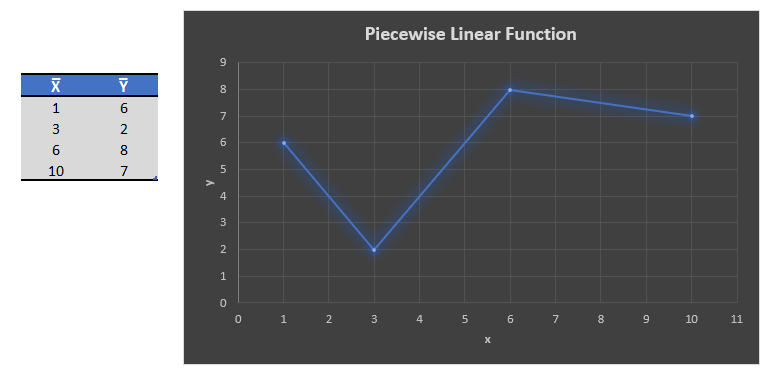
Some observations:
- We have \(K\) breakpoints \((\bar{x}_k,\bar{y}_k)\) and \(K-1\) segments,
- we assume \(\bar{x}_k\) is ordered: \(\bar{x}_{k+1}\ge \bar{x}_k\),
- we assume we have lower and upper bounds on \(x\) and \(y\),
- we assume the curve is connected (i.e. no forbidden regions for \(x\), these have to be handled separately,
- we allow step functions by adding a vertical segment (not all formulation allow this).

Finally, we note that interpolating between two points \((\bar{x}_1,\bar{y}_1)\), \((\bar{x}_2,\bar{y}_2)\) can be stated as choosing two weights \(\lambda_1, \lambda_2\) with: \[\begin{align} & x = \lambda_1 \bar{x}_1 + \lambda_2 \bar{x}_2\\ & y = \lambda_1 \bar{y}_1 + \lambda_2 \bar{y}_2 \\ & \lambda_1+\lambda_2 = 1 \\ & \lambda_1, \lambda_2 \ge 0 \end{align}\]
Method 1: SOS2 formulation
This one is the easiest to remember. Many more advanced MIP solvers have facilities for SOS2 variables. The definition is:
Let \(x_1,\dots,x_n\) be members of a Special Ordered Set of Type 2 (SOS2), then only two variables \(x_i\) can be nonzero and they have to be neighbors. All other variables are zero.
This looks like a strange animal, but in fact this construct is especially designed for cases like our piecewise linear interpolation scheme. Using SOS2 constraints, we can easily formulate a model:
| SOS2 Formulation |
|---|
| \[\begin{align} & \color{DarkRed}x = \sum_k \color{DarkBlue}{\bar{x}}_k \color{DarkRed}\lambda_k \\ & \color{DarkRed}y = \sum_k \color{DarkBlue}{\bar{y}}_k \color{DarkRed}\lambda_k\\& \sum_k \color{DarkRed} \lambda_k = 1 \\ & \color{DarkRed}\lambda_k \ge 0 \\ & \mathit{SOS2}(\color{DarkRed}\lambda_1,\dots,\color{DarkRed}\lambda_K) \end{align}\] |
Note that \(\color{DarkRed}x\) and \(\color{DarkRed}y\) are decision variables, while \(\color{DarkBlue}{\bar{x}}_k\) and \(\color{DarkBlue}{\bar{y}}_k\) are constants. The color coding helps to distinguish variables from data.
In the solution, two adjacent \(\lambda_s,\lambda_{s+1}\) will be between 0 and 1, and for these we have \(\lambda_s+\lambda_{s+1}=1\). All the others will be zero. I.e. we will be interpolating between the two corresponding breakpoints \((\bar{x}_s, \bar{y}_s)\) and \((\bar{x}_{s+1}, \bar{y}_{s+1})\). This SOS2 formulation does two things in one swoop: it selects the segment \(s\) the variables \(x\) and \(y\) belong to, and it interpolates between the two selected breakpoints.
Notes:
The Pyomo model is as follows:
It is also instructive to see how this can be modeled in a more traditional modeling language like GAMS:
Notes:
- This method is used quite a lot in practice, not in the least because it makes life easy for the modeler. It is useful to have this formulation in your toolbox.
- This approach handles step functions without a problem.
- There are no issues with big-M constants: there are none.
- However, binary variables may offer performance benefits.
The Pyomo model is as follows:
#
# expected solution X=5, Y=6
#

xdata = [1., 3., 6., 10.]
ydata  = [6.,2.,8.,7.]

from pyomo.core import *

model = ConcreteModel()

model.X = Var(bounds=(1,10))
model.Y = Var(bounds=(0,100))

model.con = Piecewise(model.Y,model.X,
                      pw_pts=xdata,
                      pw_constr_type='EQ',
                      f_rule=ydata,
                      pw_repn='SOS2')

# see what we get for Y when X=5
def con2_rule(model):
return model.X==5

model.con2 = Constraint(rule=con2_rule)

model.obj = Objective(expr=model.Y, sense=maximize)
It is also instructive to see how this can be modeled in a more traditional modeling language like GAMS:
set k 'breakpoints'/point1*point4/ ; table data(k,*) x y point1 1 6 point2 3 2 point3 6 8 point4 10 7 ; sos2variable lambda(k) 'sos2 variable'; variable x,y; equations refrow 'reference row' funrow 'function row' convexity ; refrow.. x =e= sum(k, lambda(k)*data(k,'x')); funrow.. y =e= sum(k, lambda(k)*data(k,'y')); convexity.. sum(k, lambda(k)) =e= 1; x.fx = 5; model m /all/; option optcr=0; solve m maximizing y using mip; display x.l,y.l,lambda.l; |
Results will look like:
----     29 VARIABLE x.L                   =        5.000
            VARIABLE y.L                   =        6.000

----     29 VARIABLE lambda.L  sos2 variable

point2 0.333,    point3 0.667
This is the correct solution when \(x=5\).
Method 2: Big-M Binary Formulation
In this formulation we turn on or off each linear equality depending if we select a segment. Looking at our simple example, we can state the problem as: \[y = \begin{cases} -2x+8 & x \in [1,3]\\ 2x-4 & x \in [3,6]\\ -0.25x+9.5 & x \in [6,10]\end{cases}\] We can model this "case statement" with binary variables as follows: define \[\delta_s = \begin{cases} 1 & \text{if segment $s$ is selected}\\ 0 & \text{otherwise}\end{cases}\] When \(\delta_s=0\) for a given segment \(s\), we need to make the corresponding equation non-binding, and also the corresponding limits on \(x\). This can be accomplished using inequalities and some big-M's. As an example, consider the second segment. We can write: \[\begin{align} & 2x-4-(1-\delta_2)M\le y \le 2x-4 +(1-\delta_2)M \\ & 3 - (1-\delta_2)M \le x \le 6+ (1-\delta_2)M\end{align}\] Finding good values for each \(M\) is a bit tedious. Basically we have to choose the smallest \(M\) such that each breakpoint is reachable (i.e. not cut off). For the constraint \[ y \le 2x-4 +(1-\delta_2)M\] we can write: \[ \begin{align} M & = \max_k \{\bar{y}_k - 2\bar{x}_k+4\}\\ & = \max \{ 6-2\cdot 1+4,2-2\cdot 3 + 4, 8-2\cdot 6 +4 , 7-2 \cdot 10+4 \} \\ & = \max \{8,0,0,-9\}\\&=8\end{align} \] The zero values correspond to breakpoints on the current segment.
A high level description can look like: \[\begin{align} &\delta_s = 1 \Rightarrow \begin{cases} y = a_s x + b_s \\ \bar{x}_s \le x \le \bar{x}_{s+1} \end{cases}\\ &\sum_s \delta_s = 1\\ &\delta_s \in \{0,1\}\end{align} \] where \(a_s, b_s\) are the slope and intercept for the linear function in segment \(s\). These coefficients can be calculated easily from the breakpoints \((\bar{x}_s,\bar{y}_s)\) and \((\bar{x}_{s+1},\bar{y}_{s+1})\). This implication can be implemented as follows:
| Big-M Binary Formulation |
|---|
| \[\begin{align} & \color{DarkBlue}a_s \color{DarkRed}x + \color{DarkBlue}b_s - (1-\color{DarkRed}\delta_s) \color{DarkBlue} M \le \color{DarkRed}y \le \color{DarkBlue}a_s \color{DarkRed}x + \color{DarkBlue}b_s + (1-\color{DarkRed}\delta_s) \color{DarkBlue} M \\ & \color{DarkBlue}{\bar{x}}_s - (1-\color{DarkRed}\delta_s)\color{DarkBlue}M \le \color{DarkRed}x \le \color{DarkBlue}{\bar{x}}_{s+1} + (1-\color{DarkRed}\delta_s)\color{DarkBlue}M \\ & \sum_s \color{DarkRed} \delta_s=1\\ & \color{DarkRed}\delta_s \in \{0,1\}\\ & \color{DarkBlue}a_s = \frac{\color{DarkBlue}{\bar{y}}_{s+1}-\color{DarkBlue}{\bar{y}}_s}{\color{DarkBlue}{\bar{x}}_{s+1}-\color{DarkBlue}{\bar{x}}_s} \\ &\color{DarkBlue}b_s = \color{DarkBlue}{\bar{y}}_s - \color{DarkBlue} a_s \color{DarkBlue}{\bar{x}}_s \end{align}\] |
This looks a bit more intimidating, but it is conceptually simple. Unfortunately we see some problems with the Pyomo implementation of this formulation.
Notes:
- We need 4 inequalities per segment, and one binary variable.
- This method assumes we can calculate a slope \(a_s\). For step functions we have an infinite slope when there is a vertical segment. I.e. we cannot do step functions using this method.
- It is imperative to choose reasonable values for the big-M's.
- In the model above I just used one \(M\), but actually each of them can have a different value.
- This is not a formulation I typically use: it is somewhat cumbersome to setup.
- Pyomo implements this method incorrectly, and we will get wrong results.
Method 3: Big-M SOS1 formulation
This is just a minor variant on the previous method. Instead of using binary variables, we use continuous variables that are members of a Special Ordered Set of Type 1. SOS1 sets are defined by:
Let \(x_1,\dots,x_n\) be members of a Special Ordered Set of Type 1 (SOS1), then only one variable \(x_i\) can be nonzero. All other variables are zero.
Basically we replace the binary variables: \[\begin{align} &\sum_s \delta_s = 1\\ & \delta_s \in \{0,1\}\end{align}\] by \[\begin{align} &\sum_s \lambda_s = 1 &\\ & \lambda_s \ge 0 \\ & \mathit{SOS1}(\lambda_1,\dots,\lambda_{K-1})\end{align}\] This does not change the model a lot:
| Big-M SOS1 Formulation |
|---|
| \[\begin{align} & \color{DarkBlue}a_s \color{DarkRed}x + \color{DarkBlue}b_s - (1-\color{DarkRed}\lambda_s) \color{DarkBlue} M \le \color{DarkRed}y \le \color{DarkBlue}a_s \color{DarkRed}x + \color{DarkBlue}b_s + (1-\color{DarkRed}\lambda_s) \color{DarkBlue} M \\ & \color{DarkBlue}{\bar{x}}_s - (1-\color{DarkRed}\lambda_s)\color{DarkBlue}M \le \color{DarkRed}x \le \color{DarkBlue}{\bar{x}}_{s+1} + (1-\color{DarkRed}\delta_s)\color{DarkBlue}M \\ & \sum_s \color{DarkRed} \lambda_s=1\\ & \color{DarkRed}\lambda_s\ge 0\\& \mathit{SOS1}(\color{DarkRed}\lambda_1,\dots\,\color{DarkRed}\lambda_{K-1})\\ & \color{DarkBlue}a_s = \frac{\color{DarkBlue}{\bar{y}}_{s+1}-\color{DarkBlue}{\bar{y}}_s}{\color{DarkBlue}{\bar{x}}_{s+1}-\color{DarkBlue}{\bar{x}}_s} \\ &\color{DarkBlue}b_s = \color{DarkBlue}{\bar{y}}_s - \color{DarkBlue} a_s \color{DarkBlue}{\bar{x}}_s \end{align}\] |
Notes:
- This method shows the same Pyomo bug as the big-M binary variable model: it is incorrectly implemented. See the analysis below for what is wrong.
- If a solver support SOS1 variables, it also will typically support SOS2 variables. The SOS2 approach may be easier to use.
- This method is supposedly marked for removal in future versions of Pyomo.
- We can use the SOS1 variables to prevent the need for big-M's. We can write something like \[\begin{align} & a_s x+b_s -\lambda_s \le y \le a_s x+b_s +\lambda_s\\ & \bar{x}_s - \lambda_s \le x \le \bar{x}_{s+1} + \lambda_s \\ & \sum_s \delta_s = 1\\& \lambda_s \ge 0\\& \delta_s \in \{0,1\} \\ & \mathit{SOS1}(\lambda_s,\delta_s) \end{align} \] If you look at this carefully, you can see this implements the implications: \[\begin{align} & \delta_s = 1 \Rightarrow \begin{cases} y=a_s x + b_s \\ \bar{x}_s \le x \le \bar{x}_{s+1}\end{cases}\\ &\sum_s \delta_s = 1\\ & \delta_s \in \{0,1\} \end{align} \] This is similar to how a MIP solver may rewrite implications. This particular way of dealing with an implication is a useful concept to know.
- I never have used the BIGM_SOS1 formulation in my models. It just does not look very appetizing.
A nasty Pyomo bug
To test the bigM-bin method on our simple data set I formulated the model: \[\begin{align}\max \> & y \\ & \text{piecewise on our data} \\ & x=5 \\ & x\in [1,10]\end{align}\] We expect to see as solution: \(x=5, y=6\) and an objective of 6. Instead we see:
D:\Python\Python37\Scripts>pyomo solve --solver=glpk bigm.py [ 0.00] Setting up Pyomo environment [ 0.00] Applying Pyomo preprocessing actions WARNING: DEPRECATED: The 'BIGM_BIN' and 'BIGM_SOS1' piecewise representations will be removed in a future version of Pyomo. They produce incorrect results in certain cases [ 0.60] Creating model [ 0.60] Applying solver [ 0.83] Processing results Number of solutions: 1 Solution Information Gap: 0.0 Status: optimal Function Value: 8.25 Solver results file: results.json [ 0.86] Applying Pyomo postprocessing actions [ 0.86] Pyomo Finished D:\Python\Python37\Scripts> |
Well, this is disappointing. We get a wrong solution!
We also get a warning that the Pyomo people are aware of problems with this method.
This is more wrong than what can be explained away with some numerical issues related to large big-M values. Large big-M values can lead to wrong results. I don't think that is the case here, but let's investigate.
The details of the Pyomo error
This section may become a bit dreary: we will dive into the details of this bug. Not for the faint of heart.
The model looks like the Pyomo model shown in the SOS2 section. The only difference is that we used a different method: BIGM_BIN instead of SOS2.
The solution file is:
{
"Problem": [
        {
"Lower bound": 8.25,
"Name": "unknown",
"Number of constraints": 9,
"Number of nonzeros": 21,
"Number of objectives": 1,
"Number of variables": 6,
"Sense": "maximize",
"Upper bound": 8.25
        }
    ],
"Solution": [
        {
"number of solutions": 1,
"number of solutions displayed": 1
        },
        {
"Constraint": "No values",
"Gap": 0.0,
"Message": null,
"Objective": {
"obj": {
"Value": 8.25
                }
            },
"Problem": {},
"Status": "optimal",
"Variable": {
"X": {
"Value": 5.0
                },
"Y": {
"Value": 8.25
                },
"con.bin_y[3]": {
"Value": 1.0
                }
            }
        }
    ],
"Solver": [
        {
"Error rc": 0,
"Statistics": {
"Branch and bound": {
"Number of bounded subproblems": "1",
"Number of created subproblems": "1"
                }
            },
"Status": "ok",
"Termination condition": "optimal",
"Time": 0.12992453575134277
        }
    ]
}
We see two problems:
- Clearly the Y value is wrong: it should be 6 instead of 8.25.
- We see X=5 and con.bin_y[3]=1. The last value indicates we are in the third segment. But the third segment is \([6,10]\) and does not include \(x=5\).
To debug this, we can generate and inspect the LP file. This is a bit hard to read:
\* Source Pyomo model name=unknown *\

max
obj:
+1 Y

s.t.

c_e_con2_:
+1 X
= 5

c_u_con_BIGM_constraint1(1)_:
+2 X
+1 Y
+19 con_bin_y(1)
<= 27

c_u_con_BIGM_constraint1(2)_:
-2 X
+1 Y
+8 con_bin_y(2)
<= 4

c_u_con_BIGM_constraint1(3)_:
+0.25 X
+1 Y
<= 9.5

c_e_con_BIGM_constraint2_:
+1 con_bin_y(1)
+1 con_bin_y(2)
+1 con_bin_y(3)
= 1

c_l_con_BIGM_constraint3(1)_:
+2 X
+1 Y
>= 8

c_u_con_BIGM_constraint3(2)_:
+2 X
-1 Y
+9 con_bin_y(2)
<= 13

c_u_con_BIGM_constraint3(3)_:
-0.25 X
-1 Y
+6.75 con_bin_y(3)
<= -2.75

c_e_ONE_VAR_CONSTANT:
ONE_VAR_CONSTANT = 1.0

bounds
1<= X <= 10
    -inf <= Y <= +inf
0<= con_bin_y(1) <= 1
0<= con_bin_y(2) <= 1
0<= con_bin_y(3) <= 1
binary
  con_bin_y(1)
  con_bin_y(2)
  con_bin_y(3)
end
Let's compare carefully what we expect and what we see:
| Constraint | Expected | Generated by Pyomo | Notes |
|---|---|---|---|
| Objective | \[\max\>y \] | max obj: +1 Y | |
| Segment 1 | \[ y \le -2x+8 +(1-\delta_1)M \] | +2X+1Y+19con_bin_y(1)<=27 | \(M=19\) |
| \[ y \ge -2x+8 -(1-\delta_1)M \] | +2X+1Y>=8 | \(M=0\) | |
| \[ x \ge 1 -(1-\delta_1)M \] | This one is not needed. | ||
| \[ x \le 3 + (1-\delta_1)M \] | \(M=7\) | ||
| Segment 2 | \[ y \le 2x-4 +(1-\delta_2)M \] | -2X+1Y+8con_bin_y(2)<=4 | \(M=8\) |
| \[ y \ge 2x-4 -(1-\delta_2)M \] | +2X-1Y+9con_bin_y(2)<=13 | \(M=9\) | |
| \[ x \ge 3 -(1-\delta_2)M \] | \(M=2\) | ||
| \[ x \le 6 + (1-\delta_2)M \] | \(M=4\) | ||
| Segment 3 | \[ y \le -0.25x+9.5 +(1-\delta_3)M \] | +0.25X+1Y<=9.5 | \(M=0\) |
| \[ y \ge -0.25x+9.5 -(1-\delta_3)M \] | 0.25X-1Y+6.75con_bin_y(3)<=-2.75 | \(M=6.75\) | |
| \[ x \ge 6 -(1-\delta_3)M \] | \(M=5\) | ||
| \[ x \le 10 + (1-\delta_3)M \] | This one is not needed. | ||
| Sum | \[\sum_s \delta_s = 1\] | +1con_bin_y(1) | |
| Fix | \[x=5\] | +1X=5 |
We see we have missing inequalities relating \(x\) to the segments. The cells marked in yellow indicate the missing constraints. No wonder we got the wrong results. The omission to include the condition \[\delta_s = 1 \Rightarrow \bar{x}_s \le x \le \bar{x}_{s+1}\] explains our erroneous solution: we are looking at the wrong segment.
We cannot blame the big-M's for this problem. The Pyomo piecewise function is just forgetting to include a number of inequalities.
This was an interesting exercise: debugging without looking at the code.
References
- Juan Pablo Vielma, Shabbir Ahmed and George Nemhauser, Mixed-Integer Models for Nonseparable Piecewise Linear Optimization: Unifying Framework and Extensions, Operations Research 58(2):303-315, 2010
Appendix: script to calculate big-M's in BIGM_INT and BIGM_SOS1 models
It is easy to make mistakes in the calculate of the big M values for the BIGM_INT and BIGM_SOS1 models. I used the following model to calculate them:
set k 'breakpoints'/k1*k4/ s(k) 'segments'/k1*k3/ ; table data(k,*) x y k1 1 6 k2 3 2 k3 6 8 k4 10 7 ; data(s(k),'dx') = data(k+1,'x')-data(k,'x'); data(s(k),'dy') = data(k+1,'y')-data(k,'y'); data(s(k),'slope') = data(k,'dy')/data(k,'dx'); data(s(k),'intercept') = data(k,'y')-data(k,'slope')*data(k,'x'); display data; parameter bound(*,*) 'implied bounds on x and y'; bound('x','lo') = smin(k,data(k,'x')); bound('x','up') = smax(k,data(k,'x')); bound('y','lo') = smin(k,data(k,'y')); bound('y','up') = smax(k,data(k,'y')); display bound; parameter M(*,*,s) 'tight big-M values'; M('y','>=',s) = -smin(k, data(k,'y') - data(s,'slope')*data(k,'x') - data(s,'intercept')); M('y','<=',s) = smax(k, data(k,'y') - data(s,'slope')*data(k,'x') - data(s,'intercept')); M('x','>=',s(k)) = max(0,data(k,'x')-bound('x','lo')); M('x','<=',s(k)) = max(0,bound('x','up')-data(k+1,'x')); display M; parameter num(s) 'ordinal number of each s'; num(s) = ord(s); variable x,y; binaryvariable delta(s) 'selection of segment'; equations ylo(s) yup(s) xlo(s) xup(k) select ; ylo(s).. y =g= data(s,'slope')*x + data(s,'intercept') - M('y','>=',s)*(1-delta(s)); yup(s).. y =l= data(s,'slope')*x + data(s,'intercept') + M('y','<=',s)*(1-delta(s)); xlo(s).. x =g= data(s,'x') - M('x','>=',s)*(1-delta(s)); xup(s(k)).. x =l= data(k+1,'x') + M('x','<=',s)*(1-delta(s)); select .. sum(s, delta(s)) =e= 1; x.fx = 5; model bigmbin /all/; option optcr=0; solve bigmbin using mip maximizing y; |
The output is:
----     18 PARAMETER data

             x           y          dx          dy       slope   intercept

k1       1.0006.0002.000      -4.000      -2.0008.000
k2       3.0002.0003.0006.0002.000      -4.000
k3       6.0008.0004.000      -1.000      -0.2509.500
k4      10.0007.000


----     25 PARAMETER bound  implied bounds on x and y

           lo          up

x       1.00010.000
y       2.0008.000


----     32 PARAMETER M  tight big-M values

              k1          k2          k3

x.>=                   2.0005.000
x.<=       7.0004.000
y.>=                   9.0006.750
y.<=      19.0008.000
The generated model looks like:
---- ylo  =G=

ylo(k1)..  2*x + y =G= 8 ; (LHS = 10)

ylo(k2)..  - 2*x + y - 9*delta(k2) =G= -13 ; (LHS = -10)

ylo(k3)..  0.25*x + y - 6.75*delta(k3) =G= 2.75 ; (LHS = 1.25, INFES = 1.5 ****)


---- yup  =L=

yup(k1)..  2*x + y + 19*delta(k1) =L= 27 ; (LHS = 10)

yup(k2)..  - 2*x + y + 8*delta(k2) =L= 4 ; (LHS = -10)

yup(k3)..  0.25*x + y =L= 9.5 ; (LHS = 1.25)


---- xlo  =G=

xlo(k1)..  x =G= 1 ; (LHS = 5)

xlo(k2)..  x - 2*delta(k2) =G= 1 ; (LHS = 5)

xlo(k3)..  x - 5*delta(k3) =G= 1 ; (LHS = 5)


---- xup  =L=

xup(k1)..  x + 7*delta(k1) =L= 10 ; (LHS = 5)

xup(k2)..  x + 4*delta(k2) =L= 10 ; (LHS = 5)

xup(k3)..  x =L= 10 ; (LHS = 5)


---- select  =E=

select..  delta(k1) + delta(k2) + delta(k3) =E= 1 ; (LHS = 0, INFES = 1 ****)